Berthon UK
(Lymington, Hampshire - UK)
Sue Grant
sue.grant@berthon.co.uk
0044 (0)1590 679 222
Berthon Scandinavia
(Henån, Sweden)
Magnus Kullberg
magnus.kullberg@berthonscandinavia.se
0046 304 694 000
Berthon Spain
(Palma de Mallorca, Spain)
Simon Turner
simon.turner@berthoninternational.com
0034 639 701 234
Berthon USA
(Rhode Island, USA)
Jennifer Stewart
jennifer.stewart@berthonusa.com
001 401 846 8404
September 28th, 2026
Photography © Corrin Parker
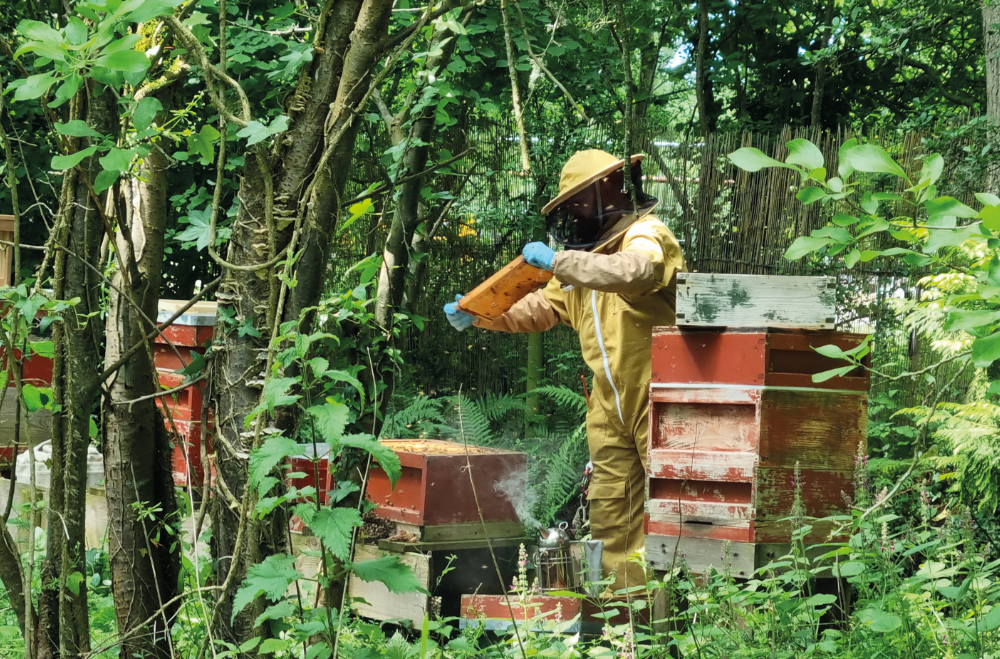
Beekeeping rarely begins with a grand plan. Often it starts with simple curiosity and a conversation that seems harmless at the time. Someone suggests the idea of keeping a hive, you look into it, and before long you find yourself standing in a garden staring at a wooden box filled with several thousand bees for which you are now responsible. That’s more or less how it began for us.

The apiary sits in Sue’s garden in the New Forest. Many people know Sue as a Director at Berthon International, but outside the office she is also the owner of a garden that opens to the public through the National Garden Scheme. It is a place where things are allowed to grow naturally, without sprays or interference, and where wildlife moves freely. Flowers spill across borders, brick paths wind between beds of foxglove, rose and hydrangea, and mature trees shelter the garden from the wind. The whole place hums quietly with life during the warmer months, and it is an ideal place for bees.

Anyone who thinks beekeeping isn’t hard hasn’t kept bees for very long. To the outsider it looks peaceful, even whimsical. The reality is very different. I’ve burned myself on a smoker, cooked inside a bee suit, cut my hand with a hive tool, and smashed my thumb building frames. I’ve stood in front of an angry colony pulling stings from my hood, and I’ve long since lost count of the times I’ve been stung. I’m writing this with eight stings on my right hand!
The first bees arrived as a nucleus colony from Paynes Southdown Bee Farms. Collecting your first nuc is something most beekeepers remember. The box looks simple, but as soon as you lift it you realise it contains a living colony. The air hums around it and the responsibility becomes very real.

Installing that first colony is nerve-wracking. Frames are lifted carefully, often with more caution than skill, and the smoker is used with hesitation. The bees, for the most part, are unconcerned, Paynes, after all, are known for their friendly bees.
Then come the small moments that make it worthwhile. Seeing eggs for the first time, tiny white grains sitting upright in the cells, is one of them. It is the first real sign that the colony is working as it should. The queen is laying, the bees are building, and the hive begins to grow.
As the colony strengthens, so does the understanding that beekeeping is not simply about owning a hive. It is about learning to read what is happening inside it. Inspections become routine, and the focus shifts from finding the queen to understanding the signs she leaves behind.
And then, just as things begin to feel under control, the bees remind you otherwise.

The first swarm is a moment that makes everything feel suddenly very real. One minute the hive appears normal and the next the air above the garden is filled with a cloud of bees.
Sue came running down to my office to tell me that her gardener had called about a large ball of bees that had formed in one of the rhododendrons at the bottom of the garden. I made a couple of quick calls, explained I was leaving to deal with a swarm, and ran out the door, telling Sue that we hadn’t got to that bit in the book yet!
My partner was furiously reading the chapter on swarms whilst I pulled on my bee suit and gathered equipment. Headphones in, I tried to set up a new hive while she narrated instructions.

Swarm catching is often described as straightforward. The reality involves ladders, boxes, and a lot of improvisation. There is always a sense it could go wrong, but when it works it feels like a small victory. That swarm became a second colony, quietly kiboshing the idea of keeping just one hive.
Soon after, the original hive, known as Blue Hive, began to behave strangely. The brood pattern was uneven and the colony unsettled. After some investigation the issue appeared to be the queen. Her mating had been unsuccessful and the colony was declining.

Replacing a queen is a strange experience. She arrives in a small cage by post, attended by a few workers, yet she represents the entire future of the colony. Introducing her requires patience and a degree of faith. For Blue Hive it worked, and the hive recovered.
By then the apiary had already begun to grow. A second nuc was added, now known as Pink Hive, along with several donated colonies. Equipment accumulated quickly. One hive became two, two became three, and before long there were five.
Turning frames of honey into jars is another learning curve entirely. Books are read, videos watched, and advice gathered, often with conflicting opinions. It becomes clear very quickly: bees will try to take their honey back if given the chance!

Eventually we moved everything indoors and the kitchen became a makeshift extraction room. Frames stacked across the floor, an extractor spinning in the middle, honey draining slowly into buckets. Our first batch came in at 16% moisture and produced fifty jars. That might not sound like much but seeing them lined up felt like a genuine achievement.
With experience comes a deeper understanding of the challenges bees face. Varroa destructor, a parasitic mite, is probably the most significant. Managing it is a turning point, the moment you realise that keeping bees requires active care throughout the year.
Varroa is only one part of the story. Colonies can fail for many reasons, sometimes despite your best efforts. Bees are both resilient and fragile, keeping them alive requires patience and attention.
Over time the rhythm of the seasons becomes clearer. Spring brings rapid growth, summer constant activity, autumn preparation, and winter survival. The work changes, but it never stops.

Despite all this, there is something deeply satisfying about keeping bees. Watching them move steadily in and out of the hive on a warm afternoon is one of those simple pleasures that never quite loses its appeal.
Beekeeping has a way of teaching patience and humility. No matter how much you read or how carefully you plan, the bees have their own ideas. Expect them to follow a plan and you quickly discover they never received the memo.
What started with a single humming box in a New Forest garden has become a proper apiary and a hobby that refuses to stay small.
Read Another Article
Download The Berthon Book 2026-2027 XXII (18.806MB)