Berthon UK
(Lymington, Hampshire - UK)
Sue Grant
sue.grant@berthon.co.uk
0044 (0)1590 679 222
Berthon Scandinavia
(Henån, Sweden)
Magnus Kullberg
magnus.kullberg@berthonscandinavia.se
0046 304 694 000
Berthon Spain
(Palma de Mallorca, Spain)
Simon Turner
simon.turner@berthoninternational.com
0034 639 701 234
Berthon USA
(Rhode Island, USA)
Jennifer Stewart
jennifer.stewart@berthonusa.com
001 401 846 8404
September 28th, 2026
Photography © Ruskin Museum
The story of the Campbell family and their BLUEBIRD world speed record boats is one of courage, engineering brilliance, obsession with speed and ultimately tragedy. It has fascinated many young boys – including a much younger Hugh Rayner!
The Campbells became synonymous with the pursuit of speed records on both water and land as Donald carried on Malcolm Campbell’s tradition by holding both water and land speed records. Their famous blue machines captured the imagination of Britain and the world during the 20th century. BLUEBIRD was a symbol of daring innovation and national pride.
Sir Malcolm Campbell, born in March 1885. A journalist and motor racing aficionado, during the 1920s, Malcolm was fascinated by the demands and challenges of breaking speed records. His racing machines were named BLUEBIRD after a stage play by Belgium’s Maurice Maeterlinck, and the bright blue colour is now permanently associated with the Campbells. So enthusiastic was Malcolm that he drove BLUEBIRD on her first outing to victory at Brooklands with her paint still wet. The Land speed record was his first target. In 1935 he was the first man to exceed 300 mph in the Campbell-Railton BLUEBIRD car, with doubled aft wheels to provide extra grip for the massive, supercharged Rolls Royce R V12 engine and air brakes fitted to slow the machine. Donald joined his father at Bonneville Salt Flats on 3rd September, to witness his crowning and retiring land speed achievement – reaching 301 mph.


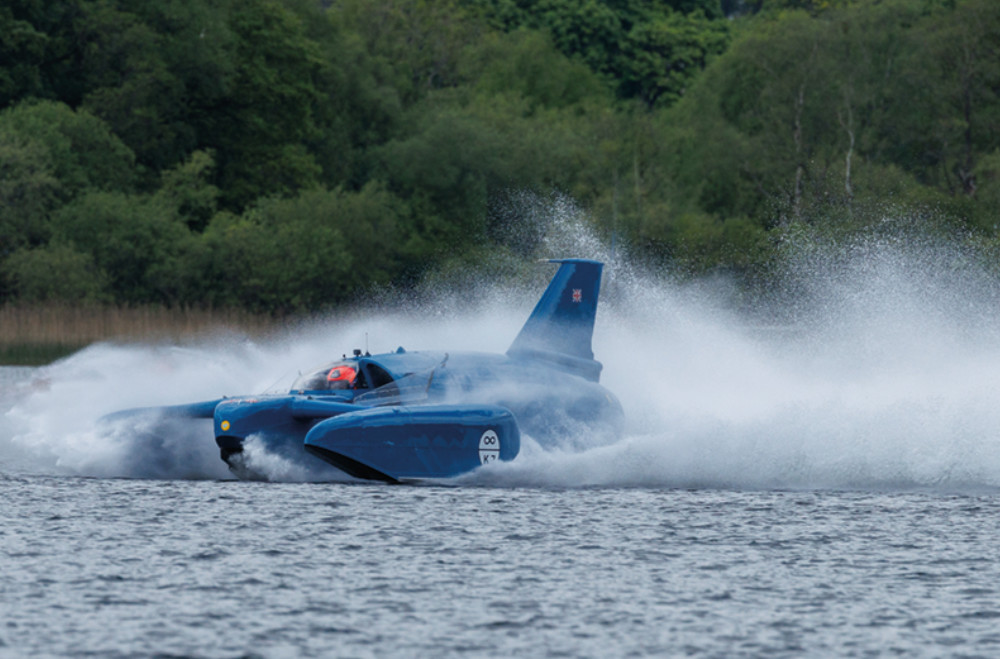
^ 1937 hydroplane K3 set 3 water speed records with Sir Malcolm Campbell at the helm. 130.91 mph reached
Malcolm’s ambitions extended beyond land, so he turned his attention to water speed records in the late 1920s and early 1930s, an arena dominated then by American Gar Wood. His early boat commissions culminated in the famous BLUEBIRD K3, a sleek hydroplane designed by Fred Cooper of Saunders Roe and powered (again) by a single Rolls-Royce R V12 aero engine. K3’s name and ∞ infinity symbol derived from her Unlimited rating with Lloyd’s. This 23’ design delivered several world water speed records during the 1930s, including reaching 126 mph at Lake Maggiore in September 1937, wrestling the 5-year record from his American nemesis, Wood. She represented a major leap forward in single-step hydroplane technology, using a lightweight design intended to plane and skim across the surface of the water at speed, with her weight positioned as far aft as possible.
Malcolm commissioned the more advanced “three-pointer” BLUEBIRD K4 design in 1939, which at speed rode on just three contact points with the surface, dramatically reducing drag, and remaining stable at higher speeds, although only to a degree.
BLUEBIRD K4 was built by Vosper and powered by the Rolls-Royce R engine used in K3. In August 1939, freshly christened K4 (Donald cracked the fizz) reached 141.74 mph on Coniston Water in the Lake District, setting a new world water speed record. The family’s long and tragic relationship with Coniston had begun…

^ Pier Cottage
The start of World War II stymied further record-breaking challenges, and when Malcolm died in 1948, the BLUEBIRD legacy passed to Donald who had grown up in the shadow of his famous father, determined to establish his own reputation. Under the terms of Sir Malcolm’s will, all possessions and record-breaking-machines were auctioned off, so Donald bought K4 back and modified her, hoping to continue the family tradition.
Donald quickly discovered the dangers of high-speed boating. In 1951, K4 suffered a catastrophic structural failure when the gearbox sheared its mountings during a test run at Coniston and thrust through the floor of the hull at around 170 mph. Unbelievably Donald survived the crash, but this accident demonstrated that propeller-driven technology was at its limits, so K4 was stripped for parts and burned on the shores of Coniston.
Convinced that the future lay in jet propulsion, even though his rival John Cobb had been killed in 1952 in his birch composite trimaran CRUSADER equipped with De Havilland’s Ghost turbojet, he worked alongside engineers Ken and Lew Norris on a long, narrow, shape resembling an aircraft fuselage mounted on hydroplane sponsons. She is of course the most famous BLUEBIRD of all: K7. Introduced in 1955, K7 was revolutionary. The world’s first successful jet-powered hydroplane featuring an all-metal, three-point design, built by Salmesbury Engineering and powered initially by a Metropolitan-Vickers Beryl axial flow, turbojet engine producing 3500 pound-force (16kN) of thrust.

^ Bluebird K7 after launch at Coniston Pier in May 2026
K7 was unlike anything ever seen on the water before, with a “pickle-fork” layout on her contact points. Donald returned to Cumbria and large crowds gathered to watch the giant blue crustacean-like vessel launch. K7’s jet engine produced enormous thrust, allowing her to accelerate with astonishing speed whilst skimming lightly across the water’s surface.
Ullswater was selected for Donald’s first successful record in K7 during July 1955. BLUEBIRD reached 202.15 mph making him the first man to exceed 200 mph on water. This was just the start of his domination. In the nine years between 1955 and 1964, K7 broke the world water speed record a staggering seven times. Progressing from 216 mph, to 225 mph, through 239 mph, and 248 mph, to accelerating to over 260 mph. Coniston’s long, straight section superseded Ullswater as the venue for these attempts, and Donald became a regular visitor to Coniston, and one of Britain’s greatest post-war celebrities. Calm, suave, articulate and impeccably dressed, he was the modern image of British engineering excellence during the 1950s and 1960s. Huge crowds gathered to witness the spectacular plume of jet spray trailing the hydroplane as K7 sped down the lake.

^ K7 BLUEBIRD
Away from Campbell’s driven persona, financial pressures were immense and taking their toll. Even sponsorship by BP, Mobil and other organisations could not cope with the vast expense of record-breaking. Donald struggled with debt and pressure to maintain interest through the achievement of ever-higher speeds. In 1964 Donald decided to challenge for both water and land speed records in the same year. Never achieved before or since, it was testament to his drive.
Campbell took his turbine-powered CN7 car Down Under. Two frustrating years followed battling conditions on Australia’s Lake Eyre, where he eventually reached 403.10 mph. Not content with the land speed record, he shipped K7 to Western Australia’s Dumbleyung Lake and set his final water speed record of 276.33 mph, with only hours to spare on New Year’s Eve 1964, becoming the most prolific breaker of the water speed record.
Donald wanted to push for the ultimate water speed record – exceeding 300 mph on Coniston. His American rivals and their massively powerful craft provided a lot of pressure – and K7’s performance was being questioned. Donald needed to impress his sponsors to help his struggling finances. In 1966, K7 was fitted with a Bristol Siddeley Orpheus jet – lighter and more powerful, loaned to him by the MOD, developing 4500 pound-force (20kN). A vertical tail stabiliser from a Folland Gnat aircraft was also added, with a hydraulically operated water brake to scrub off speed (Coniston’s course is five miles in length). K7 returned for trials in November 1966. These were beset by poor weather and technical issues, with the destruction of her Orpheus when K7’s air intakes collapsed and sucked debris into her compressor blades, writing off the engine. Donald swapped to another jet from a crash-damaged Gnat, but fuel starvation hampered top-end performance, delivering only 264 mph. A new booster pump improved the jet’s performance. Now all the team could do was wait for better weather.

^ Gina Campbell, Mr Whoppit and Dave Warby in May 2026 at Coniston
Coniston, 4 January 1967, another record run in challenging conditions, an ideal North- South run at an average of 297.6 mph slowing BLUEBIRD by applying the water brake from a high speed of 315 mph (two timed runs to count). Then, arguably the most infamous moment occurred. Passing the start of the measured kilometre at over 320 mph the three-pointers stability disintegrated, and her starboard sponson started to bounce, so K7 became airborne at over 300 mph. As we all know too well, having watched the footage time and again, K7 gracefully somersaulted, landing violently nose-first, cartwheeling across the surface as she broke up. Donald was killed instantly. BLUEBIRD was destroyed beyond the air intakes, where the cockpit is located. Donald’s mascot; his teddy, Mr Whoppit, floated to the surface, along with his driver’s helmet, but Donald and BLUEBIRD remained at the bottom of Coniston for thirty-four years.

^ Bluebird K7 passing Brantwood – John Ruskin’s wonderful house and gardens at Coniston
After a long campaign, led by surveyor/engineer/diver Bill Smith and the Bluebird Project team to raise BLUEBIRD and Donald, in 2001 they delivered. Donald was laid to rest at St Andrew’s Church, Coniston.
And what of K7? Over the years, she has been lovingly restored to running condition, surrounded by controversy and ownership disputes. Displayed at the Ruskin Museum in Coniston, she serves as a memorial to Donald Campbell and the extraordinary courage of the Campbell family.
May 2026 saw Donald’s K7 and Sir Malcolm’s 1937 K3, share the waters of Coniston at the Bluebird K7 Festival. What a sight!
Gina Campbell, Donald Campbell’s daughter said: “Let’s hope my dad is looking down on BLUEBIRD’s return… It makes my father and his band of merry men look pretty damn brilliant if you think about it.”
K7 beset by technical issues, and uncooperative Lake District weather, still touched 100 mph briefly on the Friday afternoon with Australian, Dave Warby aboard. Gina was there. She has challenged water speed records herself, whilst safeguarding the BLUEBIRD name, one of the most famous in the history of motorsport, be that land, or water.

Read Another Article
Download The Berthon Book 2026-2027 XXII (18.806MB)