Berthon UK
(Lymington, Hampshire - UK)
Sue Grant
sue.grant@berthon.co.uk
0044 (0)1590 679 222
Berthon Scandinavia
(Henån, Sweden)
Magnus Kullberg
magnus.kullberg@berthonscandinavia.se
0046 304 694 000
Berthon Spain
(Palma de Mallorca, Spain)
Simon Turner
simon.turner@berthoninternational.com
0034 639 701 234
Berthon USA
(Rhode Island, USA)
Jennifer Stewart
jennifer.stewart@berthonusa.com
001 401 846 8404
September 28th, 2026
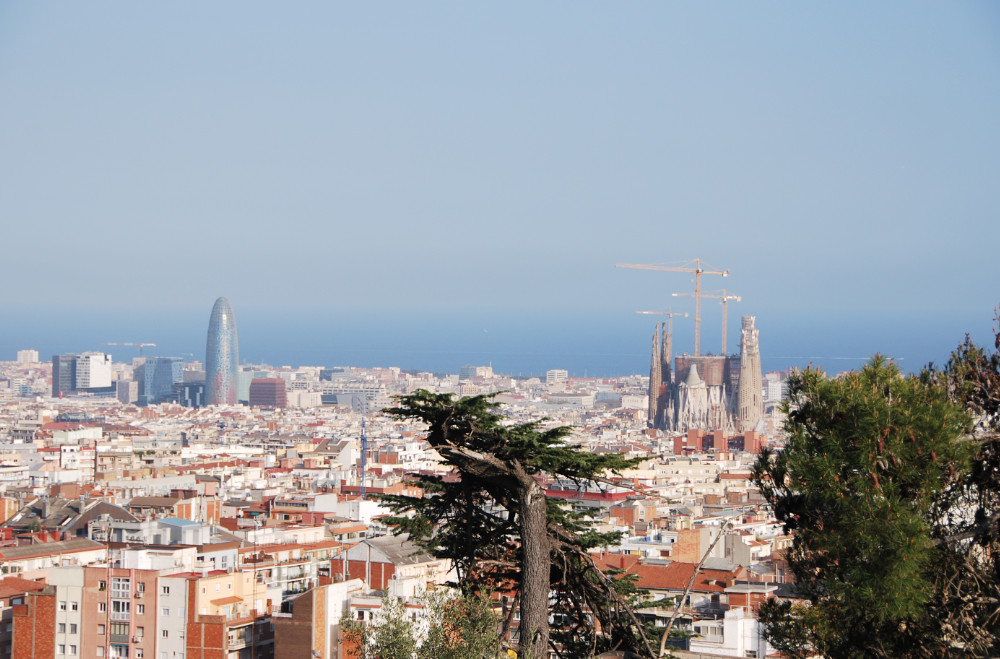
^ Barcelona in Catalonia, Spain
Behind every city wall lies a certain charm, yet few rival Barcelona, a city where architecture becomes art, and where the vision of Antoni Gaudí continues to shape its identity.

^ Passion Façade of Sagrada Família

^ Sagrada Família stained-glass windows
Born in Catalonia in 1852, Gaudí was raised in a family of craftsmen, with both his father and grandfather working as coppersmiths. From an early age, he was exposed to the process of shaping materials by hand, developing an intuitive understanding of nature, form, structure, and three-dimensional space, a skill that would later define his architectural approach.

^ Sagrada Família interior

^ Sagrada Família interior
Known for his disciplined and deeply focused character, Gaudí lived a modest and increasingly private life, dedicating himself almost entirely to his work.

^Sagrada Família exterior

^Sagrada Família exterior
His professional career began to take shape in the early 1880s, at a time when Barcelona itself was expanding and evolving. He became involved in the Sagrada Família in 1883, a project that would come to define both his career and his later life. Rather than relying heavily on traditional drawings, Gaudí often worked with three-dimensional models, experimenting with gravity and structure using hanging chains to calculate natural load-bearing forms. In his later years Gaudí became increasingly devout adopting a more austere lifestyle and dedicating himself entirely to the Sagrada Família, to the extent that he eventually decided to live on site during its construction. What began as a continuation of an existing design soon evolved into something far more personal, as Antoni Gaudí gradually transformed the basilica into a deeply symbolic and highly ambitious work, drawing on nature, religion, and geometry to create a structure unlike anything seen before.

^ Sagrada Família – intricate stone carvings and dove sculptures
While continuing work on the Sagrada Família, Gaudí simultaneously developed his architectural language through other commissions, most notably Casa Batlló (1904–1906).
Here his architecture takes on a more expressive and imaginative quality, with the facade’s flowing lines, colourful mosaic surface, and skeletal forms suggesting movement and life. The building reflects his growing confidence in moving away from rigid structure towards a more organic approach, where decoration and function become inseparable, and where storytelling through references such as the Catalan legend of Saint George plays a central role.

^ Casa Milà
Originally, Casa Batlló was not conceived as a completely new build, but as a renovation commissioned by the wealthy textile industrialist Josep Batlló in 1904. Batlló had purchased an existing, rather conventional building on Barcelona’s Passeig de Gracia and initially intended to demolish it entirely. However, Antoni Gaudí persuaded him to transform the structure instead, proposing a radical redesign that would maximise both visual impact and functional innovation. Given remarkable creative freedom by his client, Gaudí re-imagined the facade, interior spaces, and structural elements, turning what could have been a standard refurbishment into one of the most distinctive and expressive works of Modernism. The project was completed in 1906, reflecting not only Batlló’s wealth and status but also his willingness to embrace bold, unconventional design.

^ Casa Batlló

^ Casa Batlló
This evolution continues in Park Güell (1900–1914). Gaudí was given the freedom to explore these ideas on a much larger scale. Originally conceived as a residential garden estate inspired by the English garden city movement, the project instead became a space where architecture and landscape merge perfectly.
Winding paths, sculpted viaducts, and colonnaded structures appear to grow naturally from the terrain, while the use of local materials and integrated systems, such as rainwater collection, demonstrates both creativity and practicality. Together, these works illustrate the progression of Gaudí’s vision, from structured beginnings to a more fluid and nature-driven approach that continues to define Barcelona’s architectural identity.
This approach is particularly clear in the colonnaded spaces, where rows of leaning stone columns appear almost like tree trunks, slightly angled to reflect natural forces and to support the terraces above. The materials and forms throughout the park echo this idea, from rough stone surfaces to the flowing, mosaic-covered bench that wraps around the main terrace.
Antoni Gaudí used mosaics especially his signature trencadis (broken tile work) for a mix of practical, artistic, and philosophical reasons, not just decoration.

^ Park Güell

^ Park Güell
Firstly, it gave him complete creative freedom. Instead of working with uniform tiles, he used broken pieces of ceramic, glass, and stone, which allowed him to follow the curved, flowing shapes that define his architecture. Straight, standard materials simply didn’t suit the organic forms he was creating.
There was also a practical advantage. The broken tiles could easily cover irregular surfaces (curves, slopes, and uneven structures) making them perfect for projects like Park Güell and Casa Batlló. They were also durable, weather-resistant, and reflected light, helping buildings stay visually vibrant in the Mediterranean sun.
Just as importantly, mosaics connected to his inspiration from nature. The shifting colours and fragmented surfaces mimic things like water, scales, leaves, and natural textures. You can see this clearly in the shimmering facade of Casa Batlló or the serpentine bench in Park Güell. Today, Gaudí’s buildings remain among Barcelona’s most visited sites, with guided tours offering deeper insight into their design and meaning. Experiencing the Sagrada Família, Casa Batlló, or Park Güell in person highlights the full impact of his work — something that goes far beyond photographs. His legacy continues to shape the city, leaving a lasting impression on all who encounter it.

^ Park Güell

^ Park Güell
Finally, there’s a symbolic and cultural element. Using discarded materials and turning them into something beautiful reflects a kind of transformation taking the ordinary and elevating it. It also ties into Catalan craft traditions, which Gaudí valued deeply.
The cross-topped spire in the image is known as a Gaudí cross, typically formed with four arms pointing in different directions. While it has clear Christian symbolism, it also connects to Saint George, who, according to legend, defeated a dragon to save a town. Gaudí often referenced this story in his work, not in a literal way, but through suggestion and symbolism.

^ Park Güell
In Park Güell, the connection becomes more interesting when you look at the wider setting. The famous serpentine bench, covered in colourful mosaic, has often been interpreted as representing the body of the dragon, with its flowing, scaled surface echoing movement and life. The cross above, rising vertically, can be seen as a symbolic counterpart, representing faith, protection, or even the moment of victory over the dragon.
Rather than telling the story outright, Gaudí embeds it into the architecture, allowing elements like the cross, the curves, and the textures to hint at deeper cultural meaning. It’s a good example of how his work blends religion, local identity, and natural form, all within a single design.

^ Gaudí Cross – Park Güell in Barcelona
Experiencing the Sagrada Família, Casa Batlló, or Park Güell in person highlights the full impact of his work, something that goes far beyond photographs. His legacy continues to shape the city, leaving a lasting impression on all who encounter it.
Read Another Article
Download The Berthon Book 2026-2027 XXII (18.806MB)